Electric car registration, 2026
The extra fee EV owners pay, state by state
New Jersey EV owners pay $270 a year extra to register their car. 6 states charge them nothing extra. Here’s what every state adds.
Updated · Figures from each state’s official DMV or revenue pages · Download the data (CSV)
Download the graphic · Free to use with a link
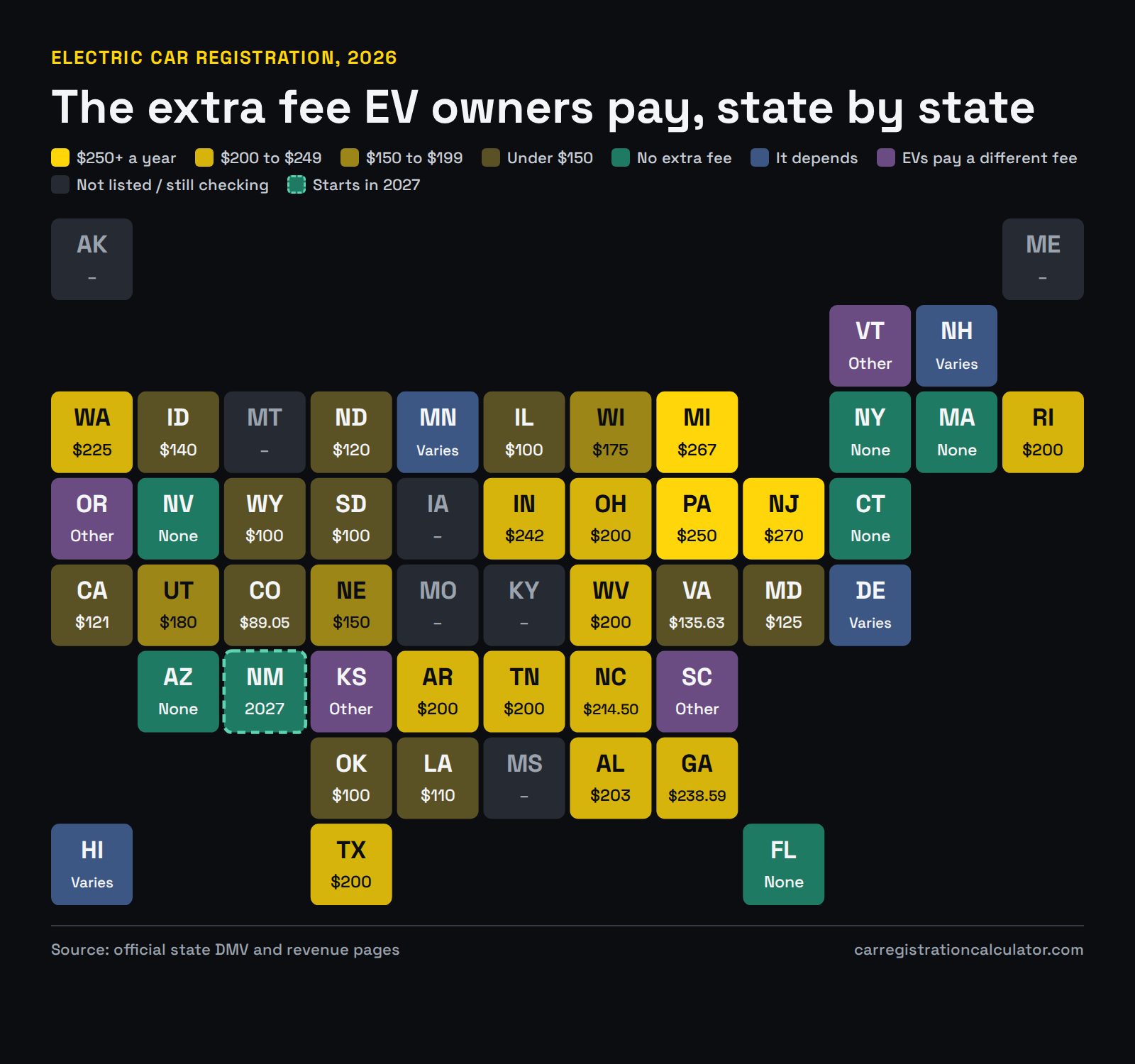
Look up your state
Alabama: EV owners pay $203 a year extra.
It goes up every fourth year; the next rise is July 1, 2027.
Alaska: no EV fee listed.
An EV fee was proposed, but we couldn’t confirm it became law.
Source: dmv.alaska.gov · Full Alaska fee guide
Arizona: no extra fee for EV owners.
Arizona has no extra electric or hybrid registration fee.
Source: www.azleg.gov · Full Arizona fee guide
Arkansas: EV owners pay $200 a year extra.
Regular hybrids: $50 a year extra.
Source: arkleg.state.ar.us · Full Arkansas fee guide
California: EV owners pay $121 a year extra.
For 2020 and newer models, at renewal. It isn’t charged when you first register a new EV bought from a dealer.
Source: www.dmv.ca.gov · Full California fee guide
Colorado: EV owners pay $89.05 a year extra.
Two parts: a $63.05 EV fee plus a $26 road usage fee, which becomes $36 the next year.
Source: dmv.colorado.gov · Full Colorado fee guide
Connecticut: no extra fee for EV owners.
Connecticut has no extra EV registration fee.
Source: portal.ct.gov · Full Connecticut fee guide
Delaware: it depends.
It depends on weight: $110 a year under 6,000 lb, and heavier EVs pay more ($150 for 6,001 to 10,000 lb).
Source: dmv.de.gov · Full Delaware fee guide
Florida: no extra fee for EV owners.
Florida EVs pay the same tax as gas cars.
Source: www.flhsmv.gov · Full Florida fee guide
Georgia: EV owners pay $238.59 a year extra.
For registrations from July 1, 2026 to June 30, 2027. It’s adjusted every July.
Source: dor.georgia.gov · Full Georgia fee guide
Hawaii: it depends.
It depends on miles driven: from $0 up to $50 a year, or a flat $50. Maui County adds its own $100 a year.
Source: www.mauicounty.gov · Full Hawaii fee guide
Idaho: EV owners pay $140 a year extra.
Source: legislature.idaho.gov · Full Idaho fee guide
Illinois: EV owners pay $100 a year extra.
Source: www.ilga.gov · Full Illinois fee guide
Indiana: EV owners pay $242 a year extra.
Paid at first registration and every renewal.
Regular hybrids: $81 a year extra.
Source: www.in.gov · Full Indiana fee guide
Iowa: still checking.
Has an extra EV fee. We’re still confirming this state’s fees, so it’s left out for now.
Source: www.legis.iowa.gov · Full Iowa fee guide
Kansas: EVs pay a different fee.
EVs pay a $165 registration fee in place of the regular $30 or $40 one (since January 1, 2026).
Source: ksrevisor.gov · Full Kansas fee guide
Kentucky: still checking.
Has an extra EV fee. We’re still confirming this state’s fees, so it’s left out for now.
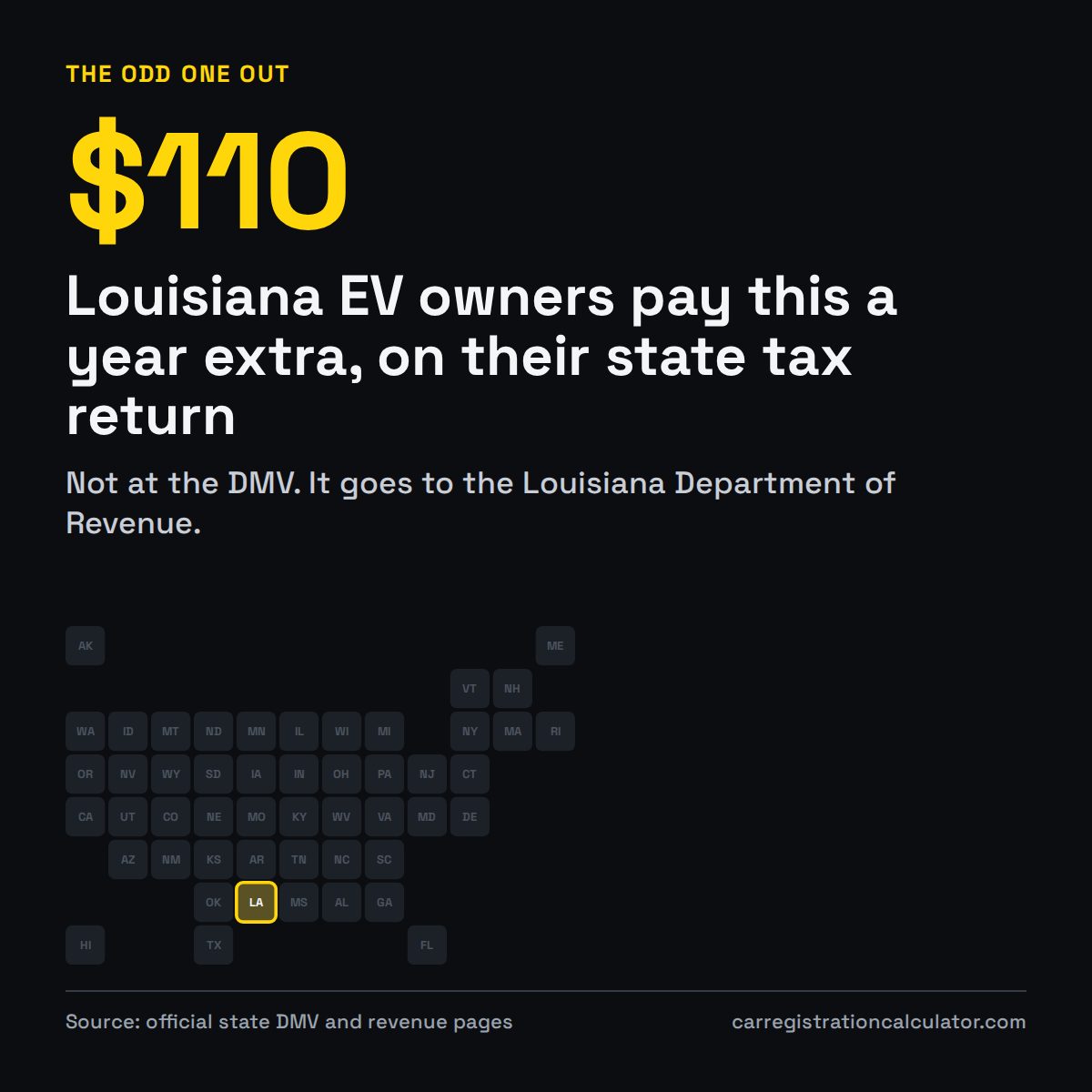
Louisiana: EV owners pay $110 a year extra.
Paid to the Louisiana Department of Revenue with your state tax return, not at the DMV.
Regular hybrids: $60 a year extra. Paid with your state tax return.
Source: dam.ldr.la.gov · Full Louisiana fee guide
Maine: no EV fee listed.
Maine’s fee schedule in our data doesn’t list an EV fee.
Source: legislature.maine.gov · Full Maine fee guide
Maryland: EV owners pay $125 a year extra.
Source: mva.maryland.gov · Full Maryland fee guide
Massachusetts: no extra fee for EV owners.
Massachusetts EVs pay the same $60 as other cars, every two years.
Source: www.mass.gov · Full Massachusetts fee guide
Michigan: EV owners pay $267 a year extra.
On top of the regular registration fee, and tied to the gas tax.
Source: www.michigan.gov · Full Michigan fee guide
Minnesota: it depends.
It depends on the car’s original price: at least $150 a year, more for pricier newer EVs. The minimum drops to $100 from July 1, 2027.
Source: www.revisor.mn.gov · Full Minnesota fee guide
Mississippi: still checking.
Has an extra EV fee. We’re still confirming this state’s fees, so it’s left out for now.
Source: www.dor.ms.gov · Full Mississippi fee guide
Missouri: no EV fee listed.
Missouri requires a yearly EV decal, but the state doesn’t publish this year’s price.
Source: dor.mo.gov · Full Missouri fee guide
Montana: still checking.
Has an extra EV fee. We’re still confirming this state’s fees, so it’s left out for now.
Source: mca.legmt.gov · Full Montana fee guide
Nebraska: EV owners pay $150 a year extra.
Charged at first registration and every renewal, under a law that took effect July 18, 2026.
Nevada: no extra fee for EV owners.
Nevada’s DMV fee page lists no EV surcharge for passenger cars.
Source: dmv.nv.gov · Full Nevada fee guide
New Hampshire: it depends.
$100 a year for now, but it becomes weight-based on January 1, 2027.
Source: gc.nh.gov · Full New Hampshire fee guide
New Jersey: EV owners pay $270 a year extra.
It rises $10 every July: $280 from July 1, 2027 and $290 from July 1, 2028. (The MVC’s 4-year online calculator still shows $250.)
Source: www.nj.gov · Full New Jersey fee guide
New Mexico: no EV fee yet; one starts January 1, 2027.
No EV fee yet. Starting January 1, 2027, EVs pay $70 a year, then $80 in 2028 and $90 from 2029.
New York: no extra fee for EV owners.
New York has no separate EV surcharge.
Source: dmv.ny.gov · Full New York fee guide
North Carolina: EV owners pay $214.50 a year extra.
Source: www.ncdot.gov · Full North Carolina fee guide
North Dakota: EV owners pay $120 a year extra.
Source: www.dot.nd.gov · Full North Dakota fee guide
Ohio: EV owners pay $200 a year extra.
For 2009 and newer models.
Regular hybrids: $100 a year extra. For 2009 and newer models.
Source: www.bmv.ohio.gov · Full Ohio fee guide
Oklahoma: EV owners pay $100 a year extra.
Source: www.oscn.net · Full Oklahoma fee guide
Oregon: EVs pay a different fee.
EVs pay $376 for a two-year registration, in place of the $126 to $216 gas-car fee set by MPG. Pay-per-mile (OReGO) drivers pay $86.
Source: www.oregon.gov · Full Oregon fee guide
Pennsylvania: EV owners pay $250 a year extra.
The 2026 amount. It’s adjusted every January 1.
Source: www.pa.gov · Full Pennsylvania fee guide
Rhode Island: EV owners pay $200 a year extra.
Billed as $400 on a two-year registration.
Regular hybrids: $50 a year extra. Even mild hybrids pay it.
Source: dmv.ri.gov · Full Rhode Island fee guide
South Carolina: EVs pay a different fee.
EVs pay a $120 road use fee every two years, on top of registration.
Source: www.scstatehouse.gov · Full South Carolina fee guide
South Dakota: EV owners pay $100 a year extra.
Plug-in hybrids pay it too.
Source: dor.sd.gov · Full South Dakota fee guide
Tennessee: EV owners pay $200 a year extra.
Charged at renewal. It rises to $274 for renewals in 2027.
Regular hybrids: $100 a year extra. Charged at renewal.
Texas: EV owners pay $200 a year extra.
A brand-new EV pays $400 up front for two years.
Source: www.txdmv.gov · Full Texas fee guide
Utah: EV owners pay $180 a year extra.
The 2026 amount, unless you sign up for Utah’s pay-per-mile program instead.
Regular hybrids: $25 a year extra.
Source: le.utah.gov · Full Utah fee guide
Vermont: EVs pay a different fee.
EVs pay $178 for a one-year registration, including an $89 EV infrastructure fee. A gas car pays $91.
Source: dmv.vermont.gov · Full Vermont fee guide
Virginia: EV owners pay $135.63 a year extra.
For July 1, 2026 to June 30, 2027. You can pay by the mile instead.
Source: www.dmv.virginia.gov · Full Virginia fee guide
Washington: EV owners pay $225 a year extra.
Charged at each renewal, not at first registration, for plug-ins with at least 30 miles of battery range.
Regular hybrids: $75 a year extra. Charged at renewal.
Source: app.leg.wa.gov · Full Washington fee guide
West Virginia: EV owners pay $200 a year extra.
Regular hybrids: $100 a year extra.
Source: code.wvlegislature.gov · Full West Virginia fee guide
Wisconsin: EV owners pay $175 a year extra.
Regular hybrids: $75 a year extra.
Source: wisconsindot.gov · Full Wisconsin fee guide
Wyoming: EV owners pay $100 a year extra.
Source: wyoleg.gov · Full Wyoming fee guide
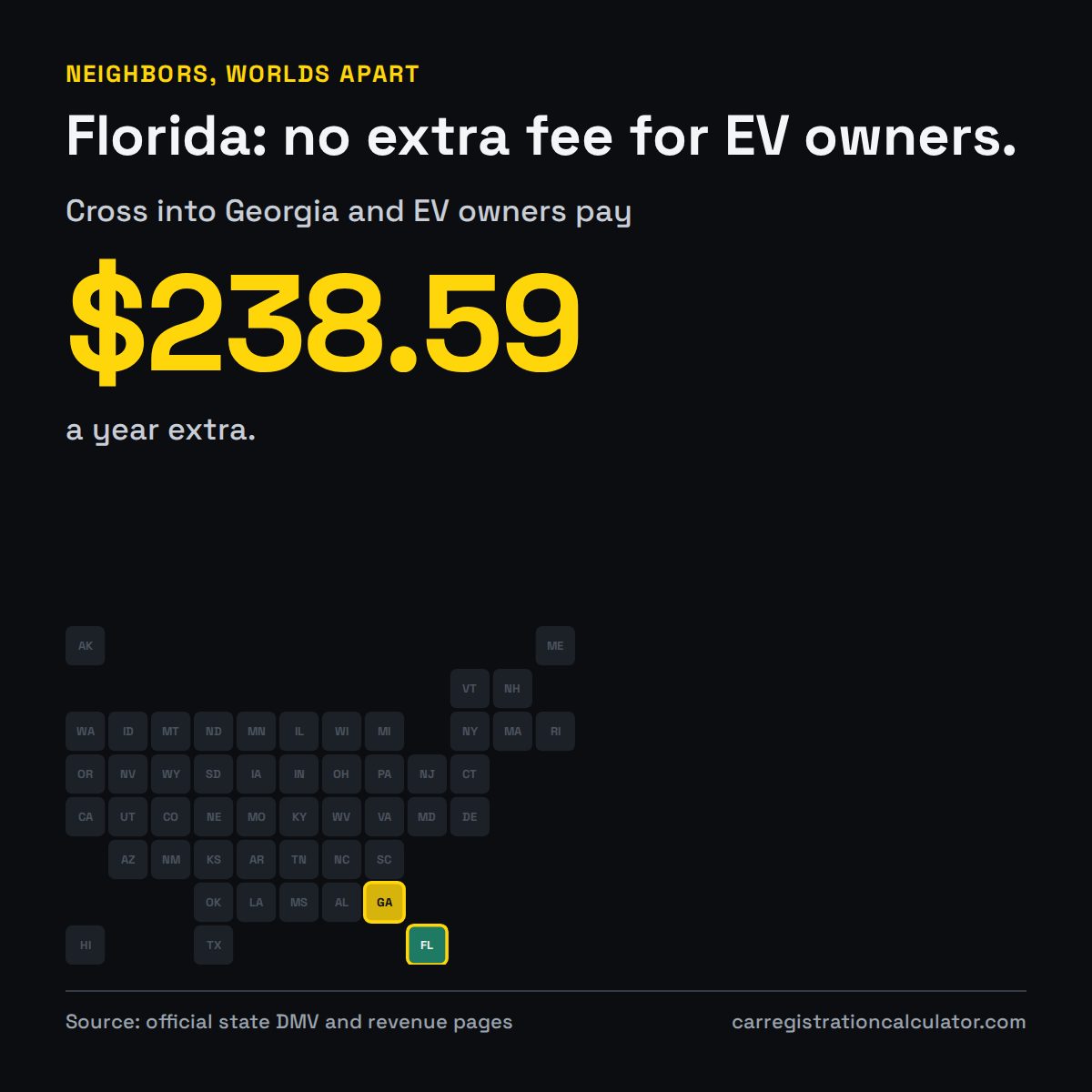
New Jersey has the biggest flat EV fee.
$270 extra a year for an EV in New Jersey
That’s more than any other state with one flat yearly EV fee, and Michigan is a close second. New Jersey’s fee goes up again every July 1 through 2028.
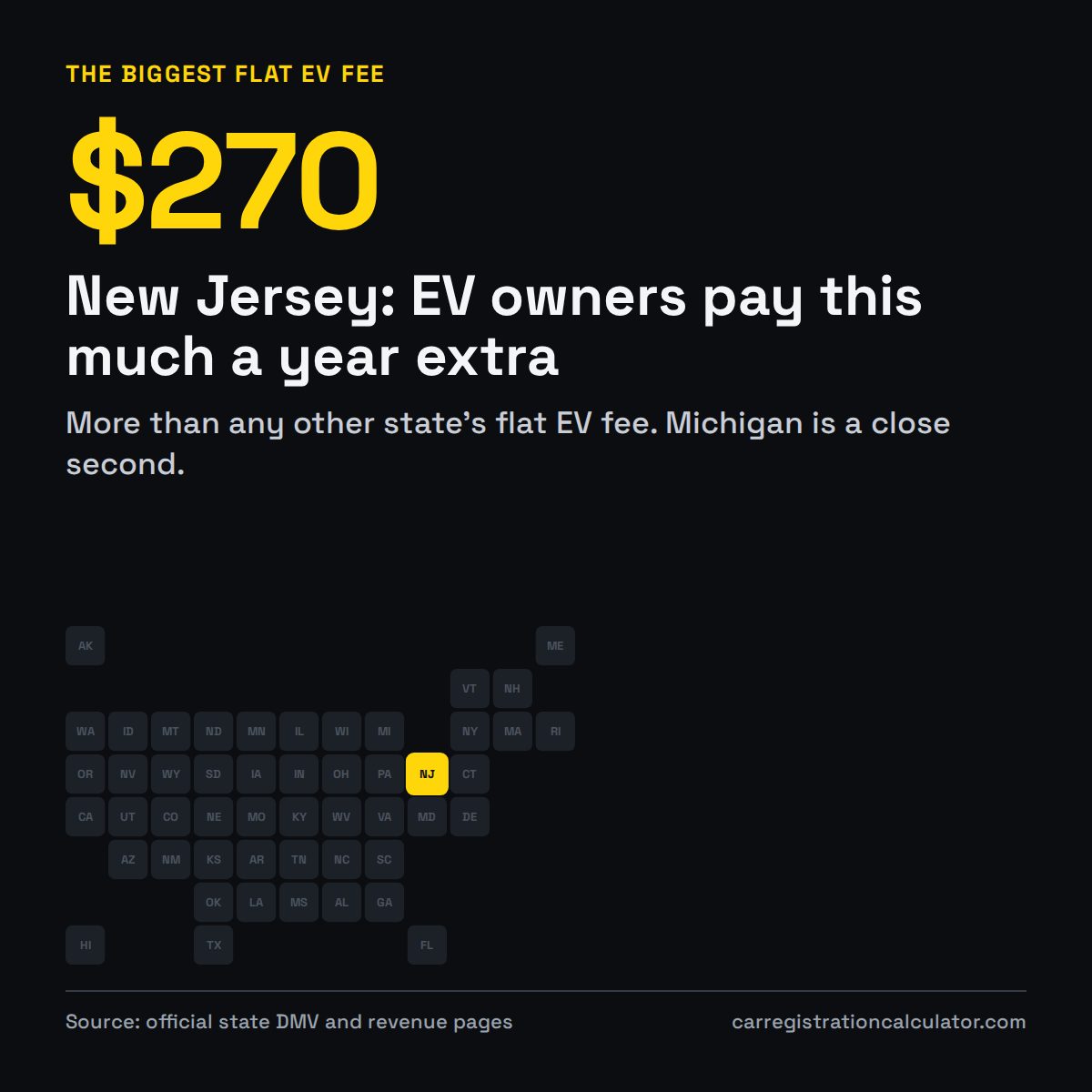
6 states charge EV owners nothing extra.
6 states with no extra EV fee
Arizona, Connecticut, Florida, Massachusetts, Nevada and New York. In these states an electric car is registered like any other car, though the regular fees still apply.
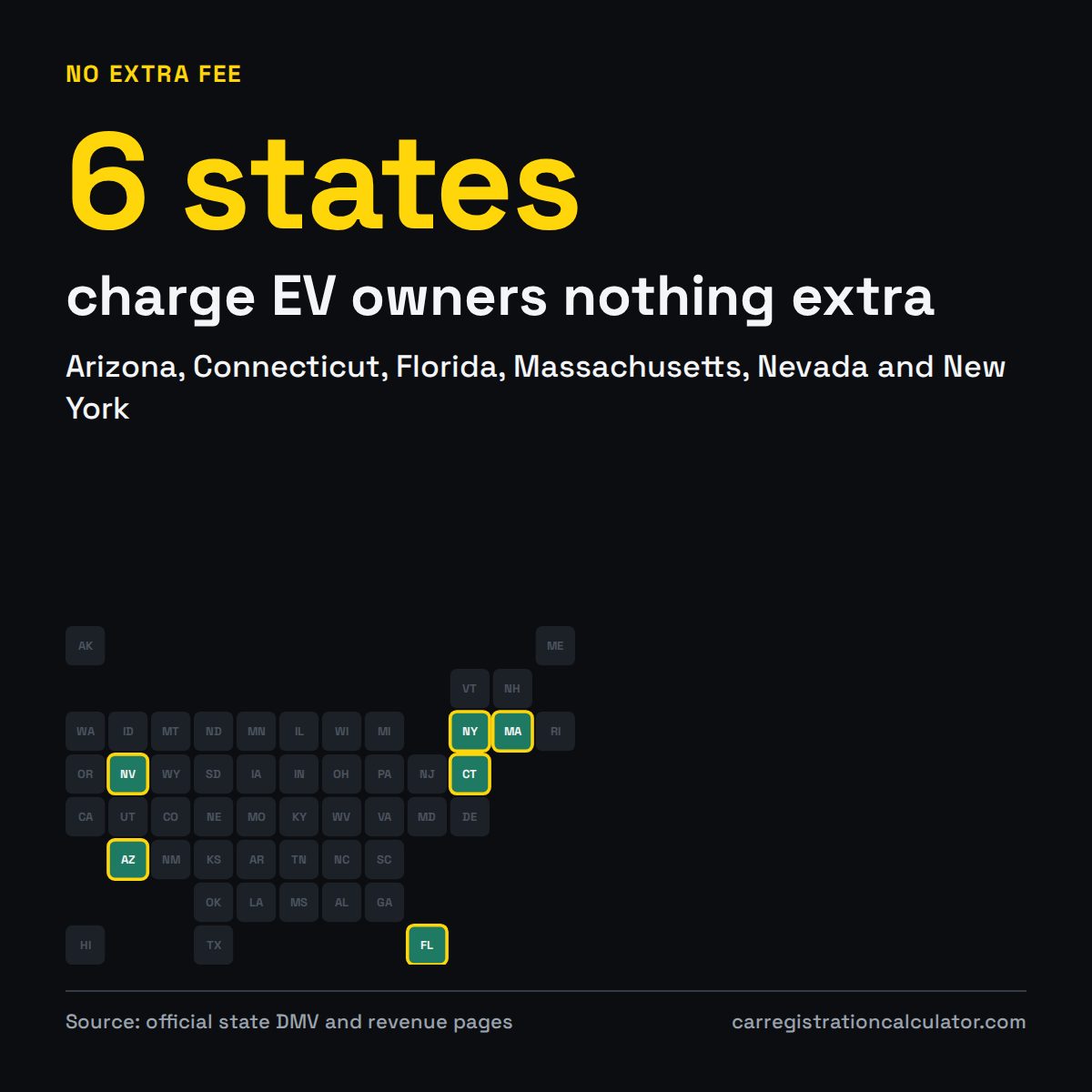
Florida charges EV owners nothing extra. Georgia, next door, has one of the biggest EV fees.
$238.59 extra a year for an EV in Georgia
Florida EVs pay the same tax as gas cars. Cross the state line and Georgia adds this every year. Alabama, Florida’s other neighbor, charges EV owners extra too.
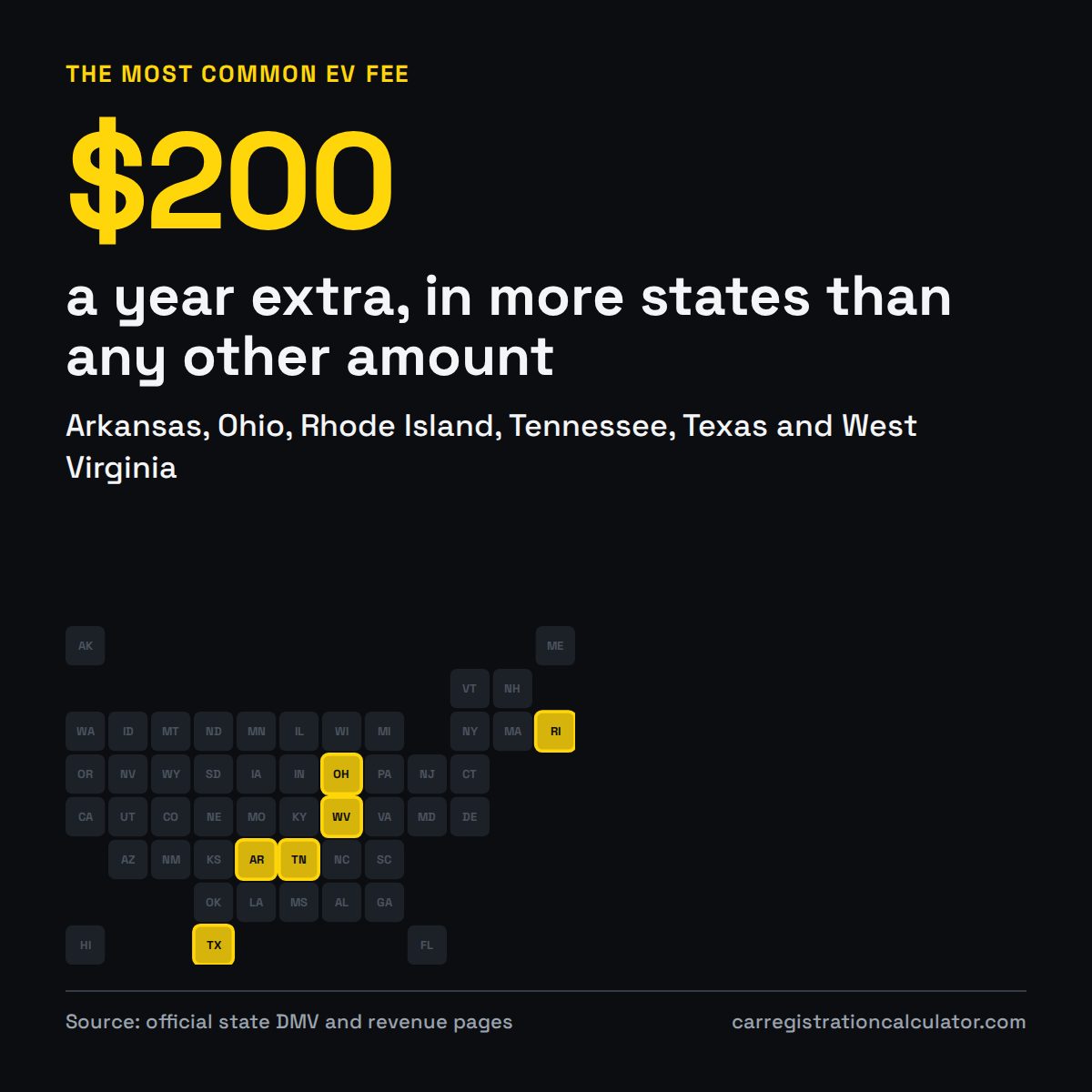
The most common EV fee is $200 a year.
$200 extra a year, in 6 states
Arkansas, Ohio, Rhode Island, Tennessee, Texas and West Virginia all charge EV owners the same amount, more states than share any other fee.
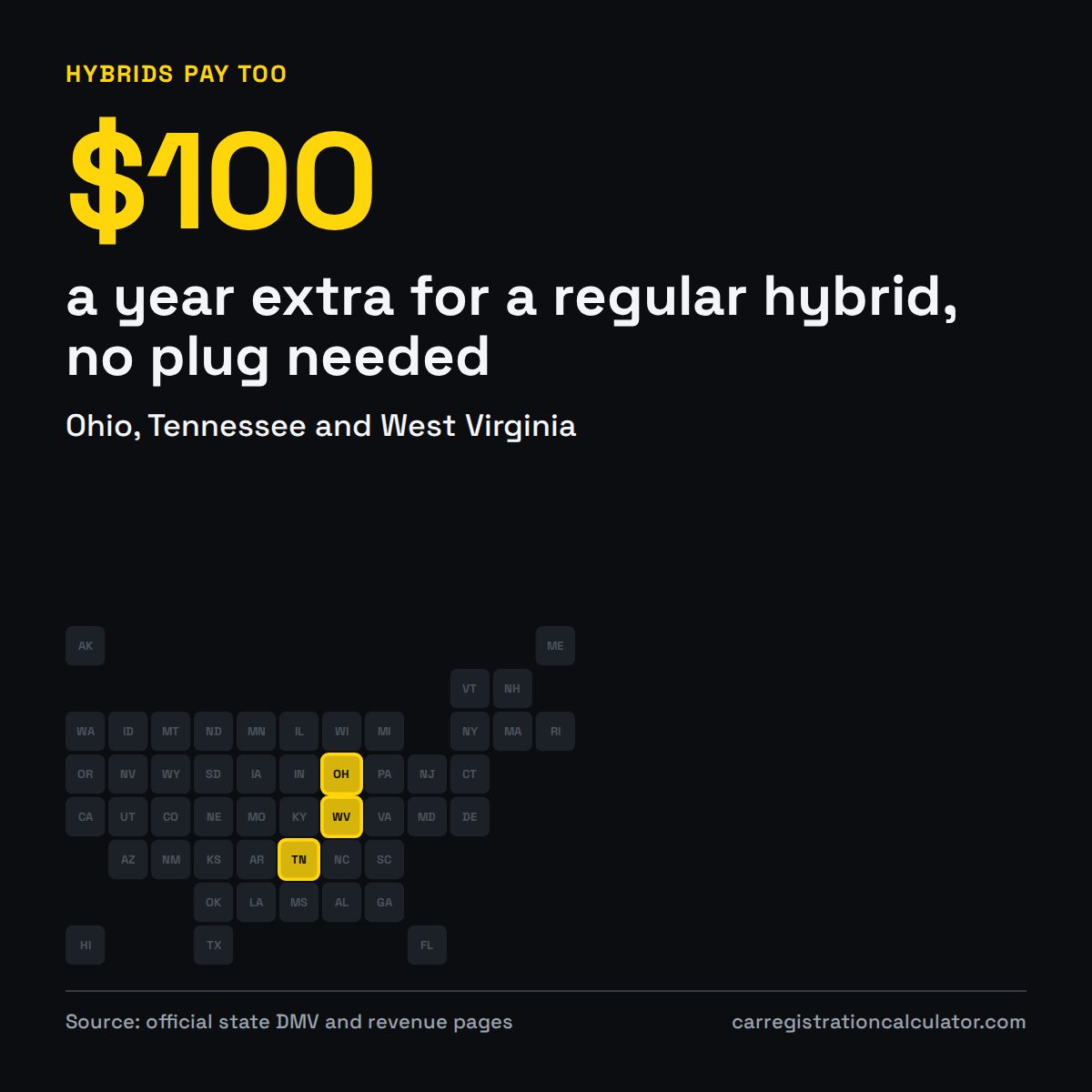
Hybrids pay extra too, even without a plug.
$100 extra a year for a regular hybrid in Ohio, Tennessee and West Virginia
That’s the most any state charges as a flat yearly hybrid fee. We found 10 states that charge regular hybrids a flat yearly fee, and Rhode Island even charges mild hybrids. See the hybrid column in the table below.
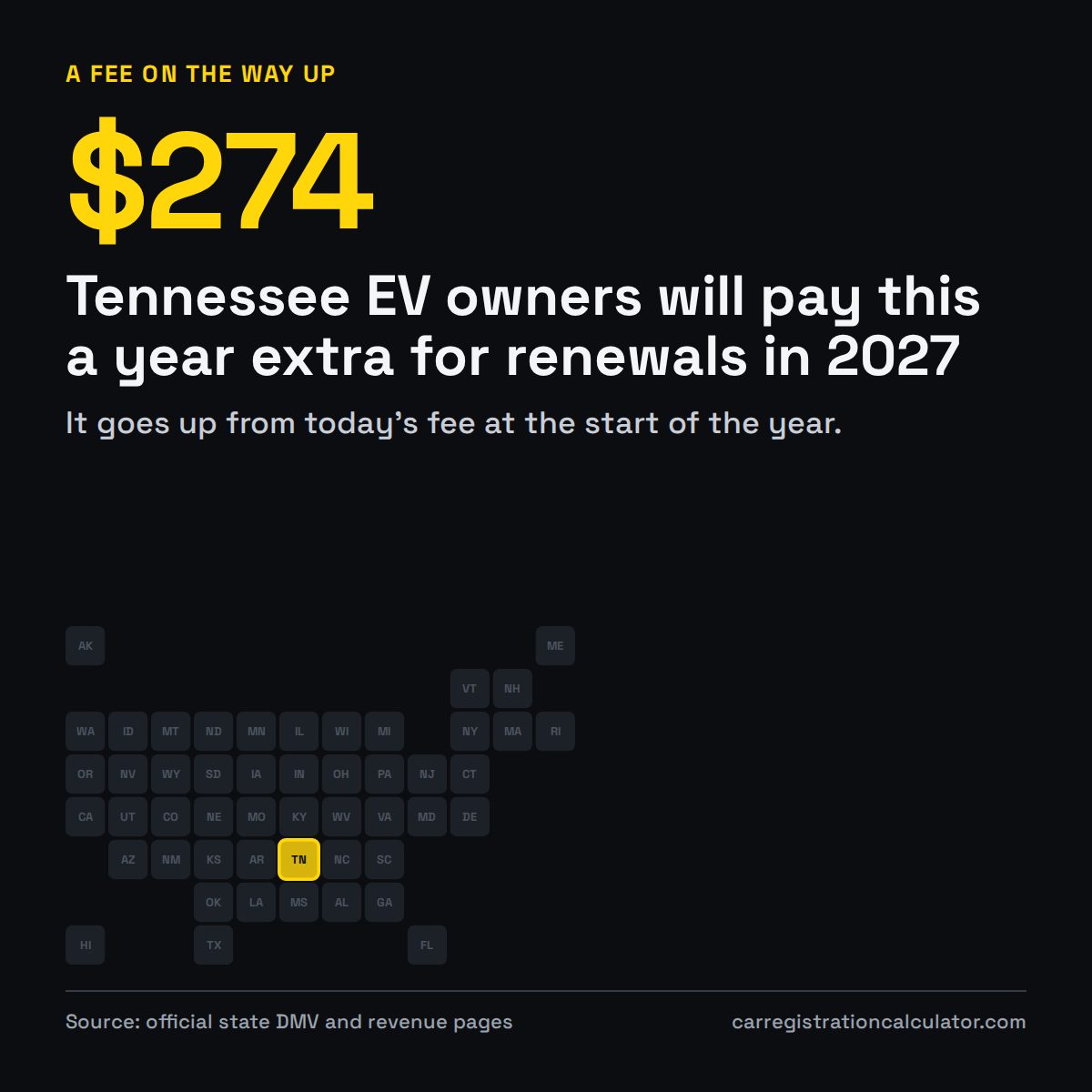
Tennessee’s EV fee goes up in 2027.
$274 extra a year for Tennessee EV renewals in 2027
That’s up from the fee Tennessee EV owners pay at renewal today, shown in the table below.
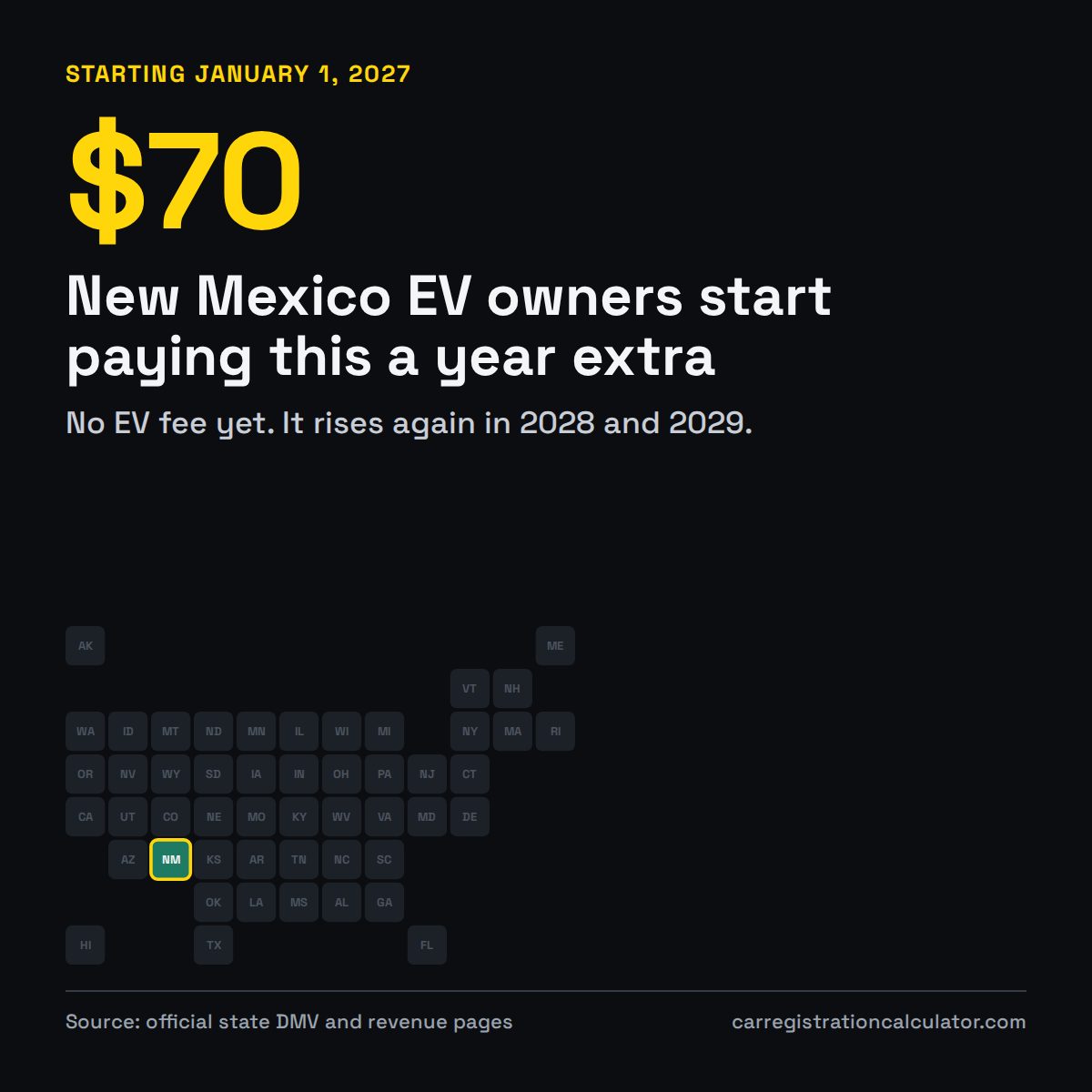
New Mexico adds an EV fee on January 1, 2027.
$70 extra a year for New Mexico EVs, starting 2027
There’s no EV fee in New Mexico yet. Once it starts, it rises again in 2028 and 2029.
Louisiana collects its EV fee on your state tax return.
$110 extra a year for an EV in Louisiana
It’s not paid at the DMV. Paid to the Louisiana Department of Revenue with your state tax return, not at the DMV.
Every state’s EV fee
Ranked from the biggest flat yearly fee. States without one are listed after, with the reason.
| State | Extra EV fee, per year | Details | Regular hybrid, per year |
|---|---|---|---|
| New Jersey | $270 | It rises $10 every July: $280 from July 1, 2027 and $290 from July 1, 2028. (The MVC’s 4-year online calculator still shows $250.) Source | – |
| Michigan | $267 | On top of the regular registration fee, and tied to the gas tax. Source | – |
| Pennsylvania | $250 | The 2026 amount. It’s adjusted every January 1. Source | – |
| Indiana | $242 | Paid at first registration and every renewal. Source | $81 |
| Georgia | $238.59 | For registrations from July 1, 2026 to June 30, 2027. It’s adjusted every July. Source | – |
| Washington | $225 | Charged at each renewal, not at first registration, for plug-ins with at least 30 miles of battery range. Source | $75 |
| North Carolina | $214.50 | Source | – |
| Alabama | $203 | It goes up every fourth year; the next rise is July 1, 2027. Source | – |
| Arkansas | $200 | Source | $50 |
| Ohio | $200 | For 2009 and newer models. Source | $100 |
| Rhode Island | $200 | Billed as $400 on a two-year registration. Source | $50 |
| Tennessee | $200 | Charged at renewal. It rises to $274 for renewals in 2027. Source | $100 |
| Texas | $200 | A brand-new EV pays $400 up front for two years. Source | – |
| West Virginia | $200 | Source | $100 |
| Utah | $180 | The 2026 amount, unless you sign up for Utah’s pay-per-mile program instead. Source | $25 |
| Wisconsin | $175 | Source | $75 |
| Nebraska | $150 | Charged at first registration and every renewal, under a law that took effect July 18, 2026. Source | – |
| Idaho | $140 | Source | – |
| Virginia | $135.63 | For July 1, 2026 to June 30, 2027. You can pay by the mile instead. Source | – |
| Maryland | $125 | Source | – |
| California | $121 | For 2020 and newer models, at renewal. It isn’t charged when you first register a new EV bought from a dealer. Source | – |
| North Dakota | $120 | Source | – |
| Louisiana | $110 | Paid to the Louisiana Department of Revenue with your state tax return, not at the DMV. Source | $60 |
| Illinois | $100 | Source | – |
| Oklahoma | $100 | Source | – |
| South Dakota | $100 | Plug-in hybrids pay it too. Source | – |
| Wyoming | $100 | Source | – |
| Colorado | $89.05 | Two parts: a $63.05 EV fee plus a $26 road usage fee, which becomes $36 the next year. Source | – |
| Arizona | No extra fee | Arizona has no extra electric or hybrid registration fee. Source | – |
| Connecticut | No extra fee | Connecticut has no extra EV registration fee. Source | – |
| Florida | No extra fee | Florida EVs pay the same tax as gas cars. Source | – |
| Massachusetts | No extra fee | Massachusetts EVs pay the same $60 as other cars, every two years. Source | – |
| Nevada | No extra fee | Nevada’s DMV fee page lists no EV surcharge for passenger cars. Source | – |
| New York | No extra fee | New York has no separate EV surcharge. Source | – |
| New Mexico | Starts 2027 | No EV fee yet. Starting January 1, 2027, EVs pay $70 a year, then $80 in 2028 and $90 from 2029. Source | – |
| Delaware | It depends | It depends on weight: $110 a year under 6,000 lb, and heavier EVs pay more ($150 for 6,001 to 10,000 lb). Source | – |
| Hawaii | It depends | It depends on miles driven: from $0 up to $50 a year, or a flat $50. Maui County adds its own $100 a year. Source | – |
| Minnesota | It depends | It depends on the car’s original price: at least $150 a year, more for pricier newer EVs. The minimum drops to $100 from July 1, 2027. Source | – |
| New Hampshire | It depends | $100 a year for now, but it becomes weight-based on January 1, 2027. Source | – |
| Kansas | Different fee | EVs pay a $165 registration fee in place of the regular $30 or $40 one (since January 1, 2026). Source | – |
| Oregon | Different fee | EVs pay $376 for a two-year registration, in place of the $126 to $216 gas-car fee set by MPG. Pay-per-mile (OReGO) drivers pay $86. Source | – |
| South Carolina | Different fee | EVs pay a $120 road use fee every two years, on top of registration. Source | – |
| Vermont | Different fee | EVs pay $178 for a one-year registration, including an $89 EV infrastructure fee. A gas car pays $91. Source | – |
| Alaska | Not listed | An EV fee was proposed, but we couldn’t confirm it became law. Source | – |
| Maine | Not listed | Maine’s fee schedule in our data doesn’t list an EV fee. Source | – |
| Missouri | Not listed | Missouri requires a yearly EV decal, but the state doesn’t publish this year’s price. Source | – |
| Iowa | Still checking | Has an extra EV fee. We’re still confirming this state’s fees, so it’s left out for now. Source | – |
| Kentucky | Still checking | Has an extra EV fee. We’re still confirming this state’s fees, so it’s left out for now. Source | – |
| Mississippi | Still checking | Has an extra EV fee. We’re still confirming this state’s fees, so it’s left out for now. Source | – |
| Montana | Still checking | Has an extra EV fee. We’re still confirming this state’s fees, so it’s left out for now. Source | – |
States that don’t fit one number
No extra fee (6)
These states say EV owners pay no extra registration fee.
- Arizona: Arizona has no extra electric or hybrid registration fee.
- Connecticut: Connecticut has no extra EV registration fee.
- Florida: Florida EVs pay the same tax as gas cars.
- Massachusetts: Massachusetts EVs pay the same $60 as other cars, every two years.
- Nevada: Nevada’s DMV fee page lists no EV surcharge for passenger cars.
- New York: New York has no separate EV surcharge.
Starts in 2027 (1)
No EV fee yet, but one is set to begin.
- New Mexico: No EV fee yet. Starting January 1, 2027, EVs pay $70 a year, then $80 in 2028 and $90 from 2029.
It depends (4)
The fee changes with the car’s weight, price or miles driven, so one number would be wrong for many drivers.
- Delaware: It depends on weight: $110 a year under 6,000 lb, and heavier EVs pay more ($150 for 6,001 to 10,000 lb).
- Hawaii: It depends on miles driven: from $0 up to $50 a year, or a flat $50. Maui County adds its own $100 a year.
- Minnesota: It depends on the car’s original price: at least $150 a year, more for pricier newer EVs. The minimum drops to $100 from July 1, 2027.
- New Hampshire: $100 a year for now, but it becomes weight-based on January 1, 2027.
EVs pay a different fee (4)
EVs pay a different regular fee, or pay on a different schedule, instead of a simple yearly add-on.
- Kansas: EVs pay a $165 registration fee in place of the regular $30 or $40 one (since January 1, 2026).
- Oregon: EVs pay $376 for a two-year registration, in place of the $126 to $216 gas-car fee set by MPG. Pay-per-mile (OReGO) drivers pay $86.
- South Carolina: EVs pay a $120 road use fee every two years, on top of registration.
- Vermont: EVs pay $178 for a one-year registration, including an $89 EV infrastructure fee. A gas car pays $91.
No EV fee listed (3)
We couldn’t find an EV fee in effect on the official pages we use.
- Alaska: An EV fee was proposed, but we couldn’t confirm it became law.
- Maine: Maine’s fee schedule in our data doesn’t list an EV fee.
- Missouri: Missouri requires a yearly EV decal, but the state doesn’t publish this year’s price.
Still checking (4)
These states have an EV fee, but we’re still confirming the amounts.
- Iowa: Has an extra EV fee. We’re still confirming this state’s fees, so it’s left out for now.
- Kentucky: Has an extra EV fee. We’re still confirming this state’s fees, so it’s left out for now.
- Mississippi: Has an extra EV fee. We’re still confirming this state’s fees, so it’s left out for now.
- Montana: Has an extra EV fee. We’re still confirming this state’s fees, so it’s left out for now.
How we checked this
Every amount comes from the state fee records behind this site’s calculator, each checked against the state’s official DMV, revenue or statute pages (linked in the table and CSV). Records were last checked between 2026-10-28 and 2026-10-29.
- What counts: the extra amount a battery electric passenger car pays on top of regular registration, per year. Regular fees, title fees, local taxes and sales tax aren’t included.
- Ranked states (28) have one flat yearly EV fee. Where a state bills two years at once, we show the yearly amount the state publishes.
- Not ranked: states whose fee depends on weight, price or miles, states where EVs pay a different base fee or pay every two years, and states we’re still checking. They’re listed above with the reason, so nobody is shown a number that doesn’t fit their car.
- “No extra fee” is used only where the state’s own records say so. Where we found nothing, we say “not listed”, not “free”.
- Dates matter: several fees change on a set date (often July 1 or January 1). We show the amount in effect now and say when it changes. Future amounts are shown only where the state has published both the amount and the date.
- Hybrids: the hybrid column shows flat yearly fees for regular hybrids without a plug. Plug-in hybrid rates differ in some states and aren’t shown.
- No math added: we don’t add, average or round any figure. Every amount is copied from the official schedule.
Suggested citation: CarReg Calculator, “The extra fee EV owners pay, state by state,” November 2026. carregistrationcalculator.com/research/ev-fee-by-state/
Use it: data and graphics are free to use with a link to this page (CC BY 4.0). Download the CSV.